
Why small balconies fail the same way every time
A balcony under about 40 square feet is not a small patio. It has one usable wall, one railing, maybe 30 inches of clear floor between the door sweep and the edge, and usually a drainage quirk nobody mentioned when you signed. Copying a patio layout onto it fails in a predictable sequence: pots drift into the walking path, everything ends up at the same height, and the space ends up both crowded and empty-looking.
Faux greenery suits this kind of square footage because it never needs a watering can dragged across the living room, and it does not mind that half the balcony sits in afternoon shade. Everything below aims at one goal: green visible at three different heights, with the floor still clear enough to stand on.

A narrow column spends floor space in inches, not feet.
Measure four numbers before you buy anything
1. The door swing, not the floor area. Open the balcony door fully and note where it stops. Anything inside that arc gets moved every single time you go out there, and anything that gets moved regularly eventually gets knocked over.
2. Railing depth. Most railings offer three to six inches of usable ledge. Anything wider overhangs whatever is below it, which is how planters disappear.
3. Any weight limit your lease mentions. Read the spec line carefully before comparing options: where a title reads Set of 2, the Weight figure covers the pair together, not per plant.
4. The sightline you want to kill. Sit in your usual chair and note what you can see. Privacy and decoration are the same job on a balcony.
Build upward: floor, railing and wall are three separate zones
The single biggest mistake on a small balcony is treating it as one surface. Treated as three zones, the same square footage roughly doubles without buying more.
Floor zone — dead corners only. The two corners furthest from the door are awkward to reach, which is exactly why tall, narrow pieces belong there. Nothing goes along the middle of the floor; that strip is circulation.
Railing zone — shallow ledges and rail planters. Short, wide pieces work best because you read them from above as much as from the side. Depth matters more than height here, since anything too wide catches the wind running along the rail.
Wall zone — above eye level. Hanging planters, a narrow shelf, anything up and out of the way. On a rental this is usually the safest place to add volume, because nothing needs fasteners — anything hung over an existing hook or rail comes down in minutes.
Privacy screening without building anything permanent
Privacy on a balcony is a silhouette problem more than a coverage problem. You rarely need solid green from floor to ceiling; you need something that breaks the line of sight at seated eye height, which is roughly 42 to 48 inches above the deck for someone sitting in a chair.
Height plus density beats width. A 47in artificial areca palm puts fine, layered fronds right in that band, and two planted toward the shared edge will screen far better than one wide, low piece.
Where the overlook comes from directly below or from a window above rather than from the side, height does nothing at all and you need volume that spreads outward instead. That is where Boston ferns with dense arching fronds earn their place — the fronds fall away from the pot and fill the gap sideways.
Everything recommended here stays freestanding. No brackets, no bolts through the railing, nothing a landlord can object to on inspection day.

Fine foliage breaks a picture-window view without solid coverage.
Narrow and tall: the shapes that buy back floor space
Width is the expensive dimension on a balcony, because it is what you walk around. Two shapes avoid paying for it.
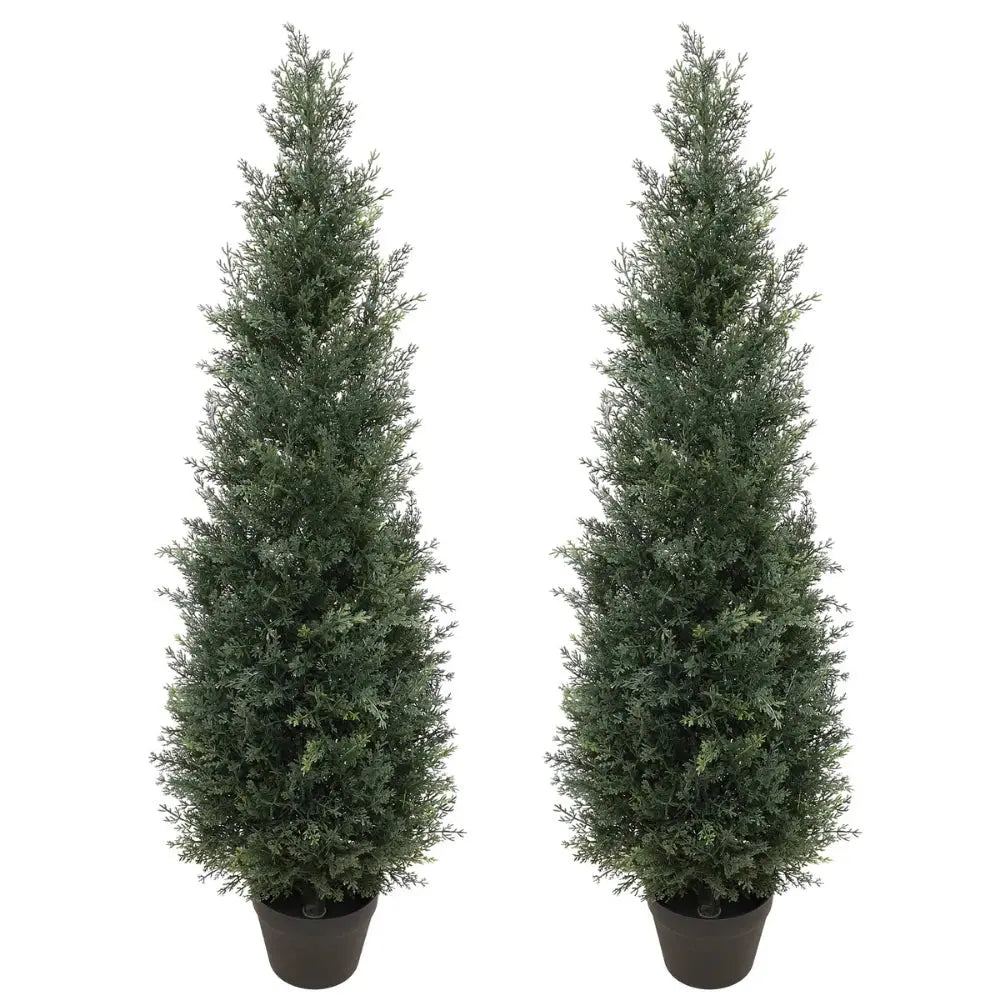
Columns. Anything that grows straight up on a single stem: cedars, spirals, narrow palms. A 4ft cedar topiary pair gives real presence at four feet while occupying barely more ground than the planter it stands in. Dark green boxwood spirals do the same job with a more formal silhouette, which suits a balcony that faces the street.
Upright spears. Agave and snake-plant forms stand vertically from a very small base and read as green without blocking anything behind them. The 47in agave sansevieria is the taller version for a floor corner; the shorter 27in agave fits a narrow ledge or a small table where anything wider would be in the way.
The trade-off to watch: narrow and tall is also top-heavy. Everything in this section needs the same treatment in the wind section below.

Wind: the thing that ruins a balcony arrangement
A balcony twenty floors up gets wind that never reaches a patio, and wind funnels along railings and around building corners. Every plant here arrives in a basic nursery pot with no added weight in the base — inside the house that makes it easy to slide a tree around while deciding where it goes, but on an exposed balcony it is the first thing to deal with.
Drop the nursery pot into a heavier decorative planter before the first windy night, with enough clearance at the rim that it does not wobble inside its new home. This matters most for exactly the shapes recommended above: anything narrow and tall catches wind along its full height.
Two habits worth keeping: check that nothing has drifted into the door swing after any rearrangement, and after strong wind, look at the pots rather than the plants — a shifted pot means the planter is too light, not that something needs reshaping. Flattened foliage teases back into place with your hands.

Three layouts that fit inside 40 square feet
The long, narrow balcony (roughly 4 × 10 ft). One column shape in each far corner — a natural place for a boxwood spiral set — mid-height green along the rail, and one stool that doubles as another surface.
The square balcony (roughly 6 × 6 ft). Keep everything against the walls and railing: a 20in olive ball pair at the railing end near the chair, one tall piece in the corner diagonally opposite the door, nothing else.
The balcony-with-a-view. Keep everything low and to the sides, because height screens the view you moved there for.
Whichever you start from, build it in one session and then leave it for a week. The most common error on a small balcony is adding one more thing every weekend until the walking path is gone.

Keeping all of it clean with no hose and no sink
Balcony greenery collects traffic dust and exhaust film faster than anything indoors, and most balconies have no outdoor tap. Three options with no plumbing: a damp microfibre cloth leaf by leaf, about two minutes on something the size of an olive ball; a cool setting on a hairdryer for dense shapes like ferns and spirals, where a cloth cannot reach between fronds; or a watering can of clean water over whatever is stood in the tub, left to drip dry.
Monthly in summer, less often for the rest of the year, and reshape while the foliage is still slightly damp — it holds shape better than working it dry.
Frequently asked questions
How many plants fit on a 40 square foot balcony?
Usually four to six pieces: two tall columns in the corners, two mid-height along the railing, and one or two small accents on whatever surface you already have. More than that and you lose the walking path.
What height do I need for privacy?
Measure from the floor to roughly seated eye height — around 42 to 48 inches — rather than aiming for full coverage. Anything above that blocks light without adding privacy.
Do balcony pots tip over in wind?
The nursery pot they ship in has no added weight in the base, so yes, on an exposed or high balcony. Slipping it inside a heavier planter solves nearly all of it, and it is worth doing the day the pieces arrive.
Is this renter friendly?
Yes. Freestanding pots and anything hung from existing hooks leave no marks and come down in minutes. Avoid brackets bolted to railings unless your lease allows them.
What if it does not fit once it arrives?
You have 30 days from delivery to return it; return terms apply, and a 10% fee is deducted from the refund. Measuring the door swing and the railing ledge beforehand prevents most of those returns.
Build three zones this weekend
If one idea carries over from this whole plan: stop treating the balcony as one surface. Corner columns take the height, the railing takes the short wide pieces, the wall takes everything else — and the middle stays walkable.
Start with outdoor topiary for the narrow columns that hold up to wind, then pull artificial plants for the railing and table level. If the sightline problem is the priority rather than decoration, artificial trees give you the 4ft-plus heights that screen properly, and agaves are the smallest-footprint way to fill a dead corner.
Everything ships free within the continental US (Alaska, Hawaii and Puerto Rico excluded), leaves our California warehouse within 24 hours on business days, and arrives in three to five business days.
Share:
Front Porch Fall Decor Ideas with Artificial Plants That Survive the Season