
Why the front porch is where faux greenery earns its keep
A porch is the least forgiving place in the house for a plant: reflected heat off the door, wind funnelling along the stoop, rain that only lands on the outer half of the mat, and nobody watering it because nobody walks past it on the way to the kettle. Potted mums are the classic autumn porch plant and the classic disappointment — a week of bloom, then a slow collapse nobody photographs.
Faux greenery has one job out there and it does it well: it holds the same silhouette on the first day of October and on the last. That matters because a front door is the one spot judged repeatedly by people standing still. Set it up once, in daylight, then leave it alone until you take it down.

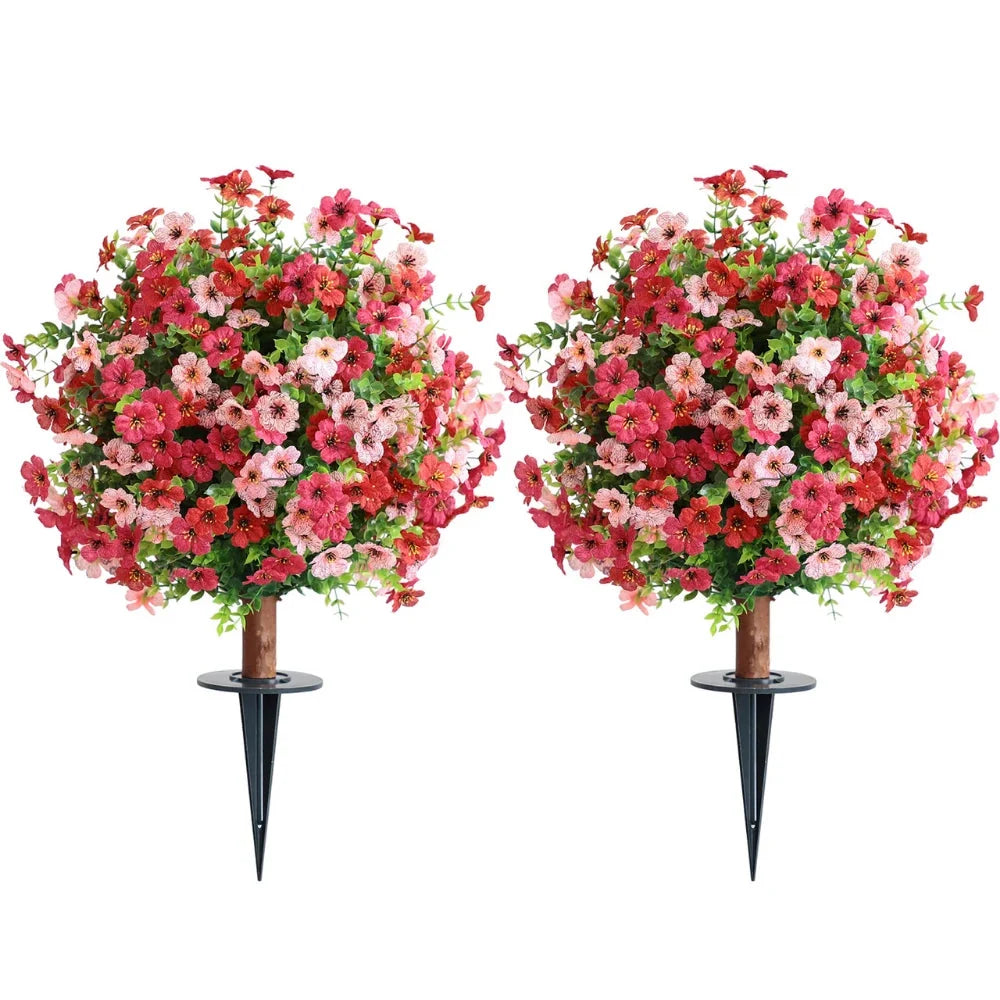
Mums are the fastest way to make a doorway read as October.
The fall palette that reads autumn instead of Halloween
Fall colour goes wrong in one specific way: everything turns orange. Orange on orange stops reading as autumn after about a week and starts reading as a costume.
Three things working together hold up better. Deep red as the anchor — berry and brick tones carry further from the street than bright orange does. Ochre and mustard as the lift — one warm yellow element keeps a red-and-green grouping from going muddy in low autumn light. Dark green as the majority — structure should be evergreen, with the warm colour sitting on top of it.
Work to roughly 60% green, 30% warm accent, 10% pale neutral. In practice that means a pair of dark green boxwood spirals as the base, with red and pink mums flower balls or orange camellia spike trees as the accents. If the house is already a warm colour, use the white and yellow mums instead — cream and yellow stop a coloured door competing with the plants.
Symmetry is the whole trick at a front door
A front door is the strongest centreline on the front of a house. Your eye finds it automatically and then checks whether the two sides match. Ignore that line and the arrangement looks accidental, however good the individual plants are.
1. Mirror across the door, not the porch. The axis is the opening, not the stoop — if the door sits off-centre, the mirror line moves with it.
2. Match heights within about two inches. A 4ft piece opposite a 3ft piece reads as a mistake from the street. Pairs like 4ft cedar topiary pair, or the 56in triple ball boxwood alongside something of similar height, solve this automatically.
3. Match the containers. Planters of different heights break symmetry just as effectively as plants of different heights. With only one good planter, group both plants in it on one side and leave the other clean.
The exception is a corner porch where the door faces the side: group everything into one asymmetric cluster near the door.

Tall evergreen at the outside, seasonal colour pulled forward, wreath at eye level.
Three height tiers, or the grouping looks flat
Most porches fail on height rather than colour. Three plants of the same height either side of a door make one flat horizontal band, and that band has no shape from the street.
Tier 1 — floor, 35 to 49in. The structure: tall and evergreen, cedars, spirals, triple-ball boxwood. It sits furthest from the door and sets the width of the whole grouping.
Tier 2 — mid, 20 to 24in. The seasonal colour. Mums flower balls and shorter camellia spikes, pulled slightly forward and inward so they read as a second layer rather than a second row.
Tier 3 — door, at eye level. A wreath hung with its centre at roughly 57 to 60in — clear of most adults passing underneath, not floating in the upper third of the door. A twig-based rose wreath is light enough for a standard hanger and pale enough to run into November.
Two tiers look unfinished; four start to crowd the walkway. Three works on almost every porch.
Five porch plans you can copy this weekend
The narrow stoop. Under 4ft of clear width, room for two things: one tall piece on the hinge side, slightly back, one 23in mums ball on the latch side, slightly forward. A narrow spiral reads better here than anything wide.
The wide porch with columns. Matching pairs at the outer edges, mums pulled in toward the steps, wreath on the door, middle kept clear.
The railing or step front. Tallest pieces against the wall or railing, mums in front, nothing on the treads — anything on a step gets knocked within a week.
The deep covered porch. Three tiers at each end, centre left as circulation. Because it is covered, brighter orange camellia spikes can go further forward here.
The apartment or shared entry. One compact grouping on the latch side, or a wreath plus one pot. Red camellia spike trees at 3ft give colour without stealing floor space from a neighbour's doormat.

Evergreen structure first, autumn colour layered on top of it.
Wind, rain and the light nursery pot
Every plant arrives in a nursery pot with no added weight. Inside the house that is a convenience — you can slide a tree around with one hand while you decide where it goes. On an exposed front step it is the first thing to fix: drop the nursery pot into a heavier decorative planter before the first windy night, and check it cannot tip inside.
Tall, narrow, top-heavy shapes need this most: a cedar or spiral catches wind along its whole height, and a doorway is where wind accelerates. Anything under about 2ft tucked against the wall rarely moves.
Two checks worth two minutes: open the door fully and see what it touches — a plant that meets the door at 90 degrees gets flattened by every delivery; and look at the doormat — if the grouping pushes people onto its edge, pull the plants back six inches.
Keeping it looking good from September to Thanksgiving
Porch greenery collects road dust, pollen and grit thrown up by rain. Monthly: cool air from a hairdryer through dense foliage, then a damp cloth on broad leaves — about two minutes a piece. After a storm: rinse with a hose on a normal setting, drip-dry, then reshape while the foliage is still damp.
About sun: a west or south facing porch that takes direct afternoon sun for a full season will gradually shift the colour of any outdoor faux foliage. Keep the seasonal colour under the roofline and give the evergreen structure the brighter spot — rotating pieces twice a season spreads the exposure around for free.

Seasonal colour lasts longest in the shade of the roofline.
Rolling the same pieces into winter without buying again
This is the reason to build the grouping around evergreen structure: it does not have to come down in November. Remove the flower balls and the warm accents after Thanksgiving and what is left — cedars, spirals, boxwood — is still a deliberate winter doorway.
Then layer back in rather than starting over: the wreath stays, the tall pair stays, the seasonal pieces return in spring. The only discipline is storage — clean everything before it goes into a box, because dust left on foliage for three months bonds to it.
Frequently asked questions
When should fall porch decor go up?
Whenever it stops looking like summer where you live — mid-September across most of the US, later in the south. With faux, putting it out early costs nothing.
Can faux mums stay out in the rain?
Yes. Rinse them afterwards and let them dry. What wears outdoor faux foliage down is long-term direct sun and being put away damp — not rain.
How many pieces does a normal porch need?
Five: two tall, two mid-height, one wreath. A narrow stoop gets away with two tall pieces and a wreath.
Will the pots blow over?
The nursery pot they ship in has no added weight, so on an exposed step or a breezy corner, drop it into a heavier planter. That one change solves almost every tipping complaint.
What if the size is wrong for my doorway?
You have 30 days from delivery to return it; return terms apply, and a 10% fee is deducted from the refund. Measure the clear width either side of the door before ordering — that number, not the porch width, decides whether a pair fits.
Build the doorway in three tiers this weekend
If you take one thing from this: evergreen structure at the outside, seasonal colour pulled forward, one wreath at eye level. That is the whole formula, and it works on a narrow stoop and a wraparound porch alike.
Start with outdoor topiary for the tall pairs that carry the grouping through winter, add mums flower balls for the October colour, and finish with a piece from wreaths on the door. If your house is already warm-toned, or you want something that lasts past Thanksgiving, artificial flowers give you camellia and rose options in the same palette.
Everything ships free within the continental US (Alaska, Hawaii and Puerto Rico excluded), leaves our California warehouse within 24 hours on business days, and arrives in 3–5 business days.

Evergreen structure is what lets the same pieces run from September into winter.

Share:
How to Fluff and Shape an Artificial Tree After Unboxing (Step by Step)