
The short answer: safer than real, but not risk-free
If the question is "will a faux plant poison my cat", the answer is close to no. There is no sap to absorb, no pollen, no bulb, no fertiliser residue and no plant toxin for a body to process. Whatever else is true of an artificial plant, the chemistry that makes living greenery dangerous simply isn't in it.
But if the question is "can my pet get hurt by one", the honest answer is yes — just not in the way most people expect. The risk moves out of chemistry and into physics. A cat can't be poisoned by a synthetic leaf, but it can swallow one, and it can shove a six-foot tree over onto itself. Once you see faux greenery as a chewing-and-toppling problem rather than a poisoning problem, the fixes are mostly common sense, and mostly about where you put things.

Height is a safety feature in a pet house, not just a styling choice.
What you are actually avoiding: the real-plant risk list
Most pet owners find out a houseplant is toxic on the way to an emergency vet. The uncomfortable part is how ordinary the offenders are — several of the most popular houseplants sold in the US appear on toxicity lists, and they sit in living rooms everywhere.
| Real plant | Who it hits hardest | What owners typically see |
|---|---|---|
| True lilies (Easter, Asiatic, daylily) | Cats — severe | Vomiting, lethargy, kidney injury; even pollen or vase water is a problem |
| Sago palm / cycad | Dogs and cats — severe | Vomiting, jaundice, liver failure; a small amount of seed or leaf is enough |
| Oleander, azalea and rhododendron | Dogs and cats | Drooling, vomiting, weakness, abnormal heart rhythm |
| Pothos, philodendron, dieffenbachia | Cats and dogs | Burning mouth, pawing at the face, vomiting |
| Dracaena | Cats and dogs | Vomiting, drooling, dilated pupils in cats |
| Ficus (weeping fig) | Cats and dogs | Oral irritation, vomiting, skin irritation from the sap |
| Snake plant (sansevieria) | Cats and dogs — milder | Nausea, drooling, vomiting |
| Chrysanthemum / mums | Cats and dogs | Vomiting, diarrhoea, drooling, contact dermatitis |
| Tulip and hyacinth bulbs | Dogs especially | Mouth irritation and vomiting; the bulb is the dangerous part |
Two caveats worth repeating. Common names overlap badly — "palm" covers everything from a harmless areca to a genuinely dangerous sago, and "lily" covers both the deadly true lilies and the merely irritating peace lily. And this table is a starting point, not a diagnosis: look any plant you own up by its botanical name, and if an animal has actually chewed something, call your vet or an animal poison line rather than waiting to see what happens.
Where faux greenery genuinely wins
Beyond the obvious toxicity point, there are quieter advantages that matter in a house with animals.
No water, no saucer, no fertiliser. Pets drink from the most inconvenient places, and the wet saucer under a real plant is a favourite — it's where fertiliser residue and standing water collect. An artificial plant has no watering schedule at all.
No soil. Which means no fungus gnats, no mould on the surface and nothing for a digger to excavate across your floor. For anyone whose cat treats every pot as a second litter box, this is the single biggest quality-of-life difference.
Nothing dropped on the floor. Real plants shed leaves, petals and pollen. All of it ends up at floor level, and floor level is exactly where a puppy finds it.
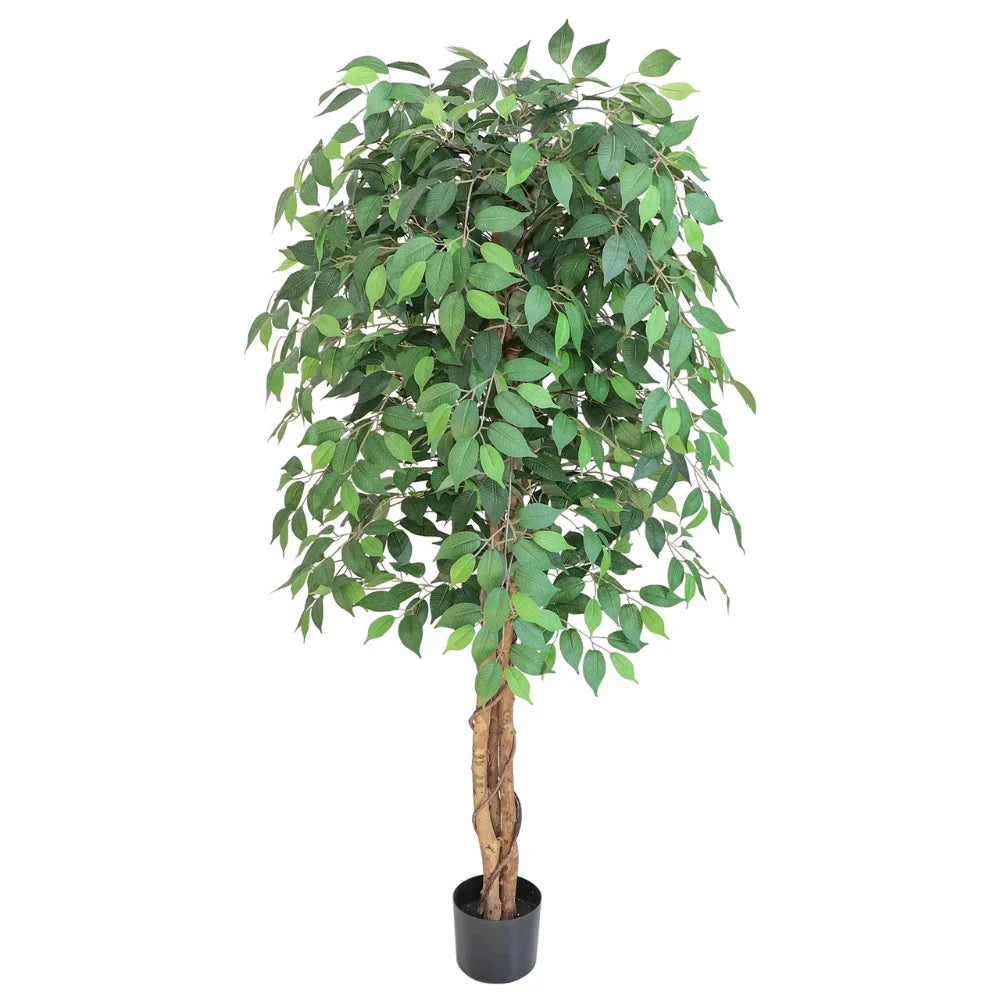
You can have the look without the species. Plenty of people want a palm silhouette in a living room, and a real sago palm is one of the worst possible choices for a dog. A faux areca palm gives you the same fronds with none of that. The same logic covers the dracaena, the tall ficus and the snake plant — all commonly flagged in their living form, all inert as decor.
The three risks that do remain
1. Swallowed pieces. This is the real one. Small detachable parts — petals, bloom heads, individual leaves — are what end up in a stomach. A cat that bats at a mums flower ball until a bloom comes loose will very often then try to eat the bloom. Long, narrow leaves are the other concern, because stringy material is harder to pass than something small and soft.
2. What's inside the stems. The foliage is held on wired stems built around a rust-resistant metal frame. A dog that works one branch over for an afternoon can eventually expose a wire end or snap off a stiff piece. If you find shredded foliage, check the branch before you put it back; if wire is showing, retire the piece or move it somewhere the animal can't reach.
3. Toppling. Every tree we sell ships in a nursery pot with no added weight. That's fine on a sheltered floor and less fine when a large dog cuts a corner at speed. A 9ft olive tree in a light pot is a genuine tipping risk in a busy hallway.

Anything small enough to fit in a mouth and loose enough to come off, will eventually come off.
Shapes that invite trouble, and shapes that don't
Not all faux plants are equally interesting to an animal, and the pattern is predictable once you've watched one for a week.
High interest: anything with many small parts at nose height, anything that dangles and moves when batted, and anything with thin upright blades. Dense, dangling fronds are cat magnets precisely because they move — a Boston fern is the classic case. So are stiff blade shapes like the agave and snake plant forms. None of these is dangerous as an object; they're just fun, and fun gets chewed.
Lower interest: tall single-trunk trees with firm branches, big smooth leaves that are awkward to get a mouth around, and anything whose canopy sits clearly above head height. A broad-leaf ficus in a corner gets sniffed once and then ignored.
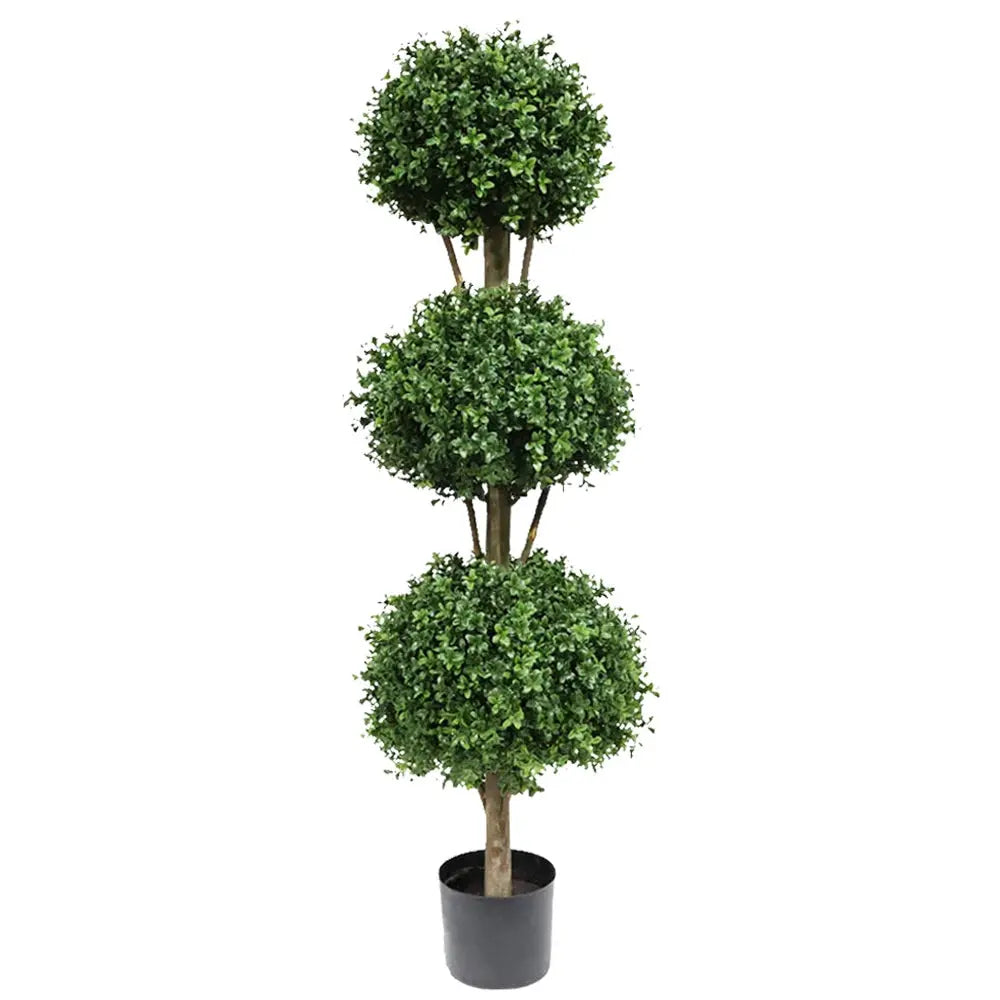
The small-piece rule: if a part is small enough to fit in a mouth and it can come off, assume it will come off eventually. That's an argument for pieces with foliage attached firmly, and an argument against putting little tabletop accents where a cat walks. A pair of small olive ball topiaries looks lovely on a low console — and is exactly the wrong height in a house with a chewer.
Placement rules that survive a cat
Measure from the launch point, not from the floor. Cats don't jump from the ground; they jump from the sofa arm, the sideboard, the top of the bookcase. Before you commit to a shelf, stand where the cat stands and see what's within reach.
| Spot | Verdict | Why |
|---|---|---|
| Floor corner, clear of furniture | Best | No launching pad, and a heavy planter can sit flat and stable |
| Beside a sofa or armchair | Risky | The armrest delivers the cat straight into the canopy |
| Low console or coffee table | Worst | Eye height, easy reach, and one shove sends it over the edge |
| High shelf with clearance above | Good | Out of reach as long as there's nothing climbable beside it |
| Hanging basket over a walkway | Depends | Fine if it's genuinely high; otherwise a tail-swisher empties it |
Two more that people forget. Keep the first fortnight boring (below). And don't put anything you care about where it blocks a route the animal uses daily — a plant in a doorway or at the foot of the stairs will get barged into no matter how much the cat respects it.
Make the base pet-proof: weight, filler and planters
Three practical steps, in the order that they help.
Drop the nursery pot into a heavier planter. Every tree arrives in a nursery pot without added weight, so the pot is the weak point rather than the plant. A ceramic or stone planter that fits snugly around it changes the whole equation — the piece stops being knockable and looks finished at the same time. If there's a gap at the rim, close it so nothing can be pulled out.
Be careful with decorative toppers. Loose pebbles, bark nuggets and preserved moss look great and are exactly the wrong size: small, interesting and easy to swallow. If your pet mouths things, use a fitted inner rim or a solid cover instead of a loose topper.
Read the weight properly. The weight in the specs is the total for the piece, so when a title says "Set of 2" that figure covers both trees. Halve it before you judge how easily one will tip. It's the number to check before you put anything tall at the top of a run.

The nursery pot goes inside something heavier — it fixes stability and looks better at the same time.
The first two weeks: how to introduce it
Don't place a new plant and hope. For the first fortnight, put it where the animal already spends time and watch what happens — two weeks of observation is faster than any amount of guessing.
Check the floor each morning. Whatever comes off will be there, and it tells you immediately whether the piece is being chewed or merely sniffed. Sweep it up: a pet that finds yesterday's petal on the carpet will try it again.
Offer a better option. Cats that chew foliage are often just looking for something to chew, and a pot of cat grass on a windowsill redirects most of them cheaply. Put the alternative close to the faux plant at first, then move it once habits settle.
If the animal wins, move the plant. Deterrent sprays exist and some owners swear by them, but results vary a lot between animals, and a spray is not a substitute for putting the thing out of reach. Relocating a plant costs nothing.

Dangling fronds are the most-batted shape in the house. Height, not training, is the fix.
Frequently asked questions
Can a faux plant poison my cat or dog?
Not in the way real plants do — there is no toxin, sap, pollen or fertiliser involved in the first place. What can happen is a swallowed fragment, which is a physical problem rather than a poisoning. If you know or suspect a piece is missing, call your vet; if you can find the fragment, take it with you.
Are the products I clean it with safe around pets?
Keep animals out of the room while you clean and let everything dry before they come back — it's the residue that matters, not the plant. Avoid essential-oil sprays and solvent cleaners around cats in particular. The routine in our guide to cleaning artificial plants is mild soap and water, which is the safest option in a house with animals.
Is a real "pet-safe" plant a better choice?
Sometimes. Boston fern, areca palm and phalaenopsis orchid are commonly listed as non-toxic for cats and dogs, and you'll find faux versions of all three — the areca palm and the white phalaenopsis orchid among them. But non-toxic doesn't mean harmless: a dog that eats half a real fern will still be sick from the fibre, and real plants still need light, water and soil. Most pet owners end up with a mix — one or two real plants they can genuinely look after, and faux for the corners that don't work.
My dog keeps knocking the tree over. Now what?
Fix the base first: nursery pot into a heavier planter, gap closed, flat on the floor. Then move it out of the traffic line, because most knock-overs happen in routes rather than in corners. If it still goes down, go shorter and wider rather than taller.
Does dust matter where pets are concerned?
Only in the way it matters for you. Dusty foliage sheds more, and whatever falls ends up on the floor where a pet can find it. A monthly wipe keeps that close to nothing.
Choose shapes that don't invite trouble
If you're furnishing a room with animals in it, start with height and a heavy base, then worry about colour. Tall single-trunk trees, broad leaves that are awkward to mouth, and planters heavy enough to shrug off a shoulder-check will outlast any amount of training.
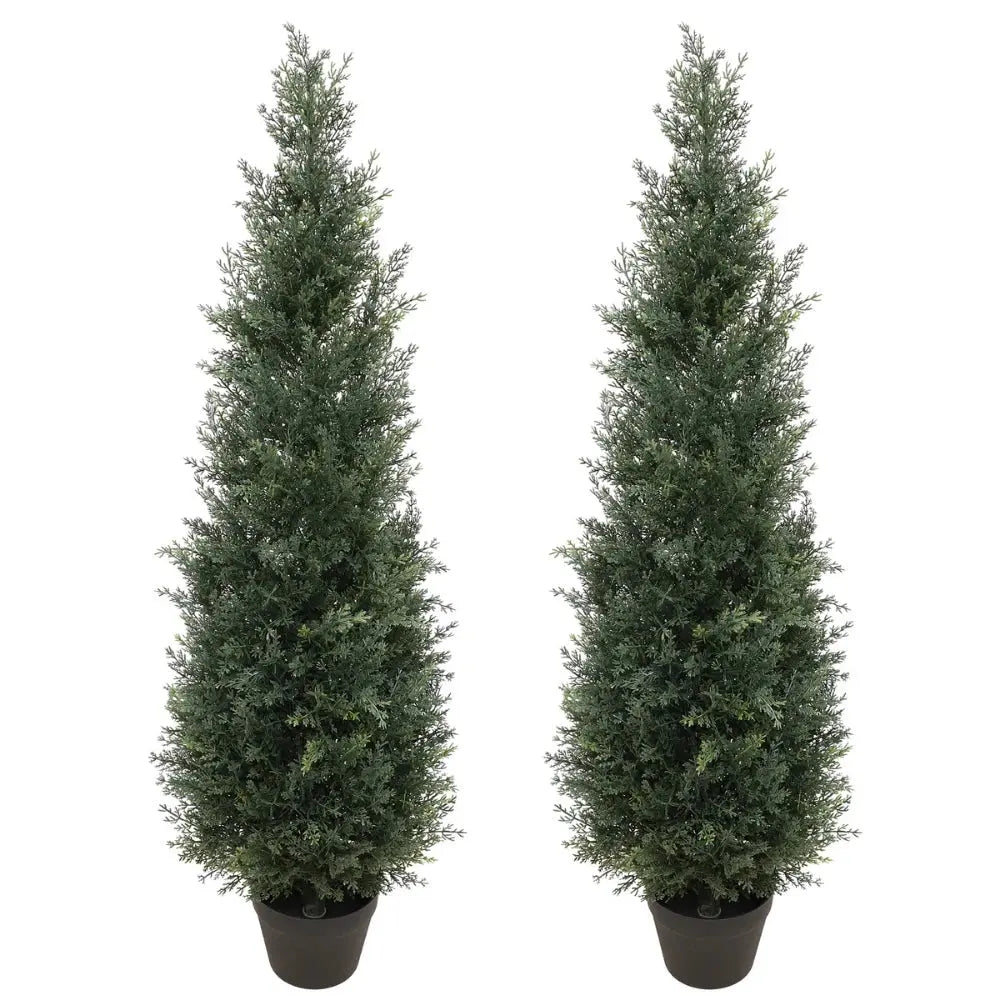
Browse artificial trees for the tall corner pieces, artificial plants for room-scale greenery you can place up high, and outdoor topiaries if you want something by the door. Everything ships free within the US (Alaska, Hawaii and Puerto Rico excluded), leaves our California warehouse with orders processed within 24 hours on business days, and arrives in 3–5 business days. Try it in the room for 30 days — returns are accepted in that window with a 10% restocking fee (return terms apply).

The palm look, without the species you'd have to worry about.
Share:
Halloween Decor with Artificial Plants: Spooky Curb Appeal, Zero Mess
Do Outdoor Artificial Plants Fade in the Sun? What Actually Happens