
Why outdoor greenery loses color: what sunlight actually does
Do outdoor artificial plants fade in the sun? Yes. Not in a week, and not always dramatically — but it happens, and pretending otherwise is why people feel misled by a porch planter that looked perfect in June and chalky by September.
The mechanism is not mysterious. Sunlight carries ultraviolet energy, enough to break chemical bonds in the colorants that make a leaf read green and in the polymer the leaf is made from. Alter the colorant and the leaf shifts lighter, yellower or grey. Alter the polymer and the surface goes powdery and stiff.
Heat multiplies it. A dark leaf against a sun-baked wall is not at air temperature — direct sun in front, radiant heat behind. Reactions run faster when hot, which is why one product can look near-new after two seasons in Seattle and tired after a single summer in Phoenix.

Two identical plants, two climates, two outcomes — exposure is the variable.
The four variables that decide how fast it happens
These four decide most of the outcome, and three of them have nothing to do with what you bought.
1. Sun hours and intensity. All-day direct sun differs categorically from morning or dappled light. Reflective surfaces count too — a white stucco wall, pale paving or a pool bounce light back onto the foliage.
2. Heat load, separately from light. Two inches of air between foliage and a hot wall is worth more than most things people spray on.
3. Wet-dry cycling. Rain, dew and overspray soak and dry foliage repeatedly; the minerals left behind build a film that holds heat and flattens color.
4. Which faces take the hit. The top and the sun-facing side go first. A plant never turned ends up with one bleached shoulder and one good side.
Deliberately absent from this list: dust. A dusty plant looks faded and usually is not — wash one leaf and compare before concluding anything.
Fading is not the only ending: chalking, brittleness and droop
Three different failures get called "it faded", and only one of them is about color.
Chalking is a powdery white or grey film you can rub off with a thumb — the surface layer breaking down. Wash it away once and the surface underneath is thinner for it.
Brittleness shows at the extremities: leaf tips snap, fronds crack at folds, slender stems break when reshaped. That is lost flexibility, not lost color.
Droop is the third: stems stop holding a bend and a shaped canopy slowly closes up. Construction matters here. Our stems sit on an internal metal frame that is rust-resistant, so the frame carries the load rather than the plastic — which is also why a branch holds the angle you set and can be reshaped seasons later.
The test is simple. Wash a leaf: if the color comes back, you had dirt; if not, that is real degradation, and nothing reverses it.
Where you place it matters more than what you paid
Rank your own exposures before spending anything. Harshest is all-day sun against a west or south wall, especially a light-colored one that reflects. Then open yard with afternoon shade only, then a covered porch taking morning sun, then deep shade, where fading is largely a non-issue.
The biggest lever is a roof. Under an eave or a deep entryway a plant misses most of the sun and the worst of the rain, and that does more for it than anything you can apply. A 4.3ft olive cone pair flanking a covered doorway is close to the ideal case. Failing a roof, use the building's own shadow: moving a planter two feet can shift it from a five-hour sun slot to a two-hour one.
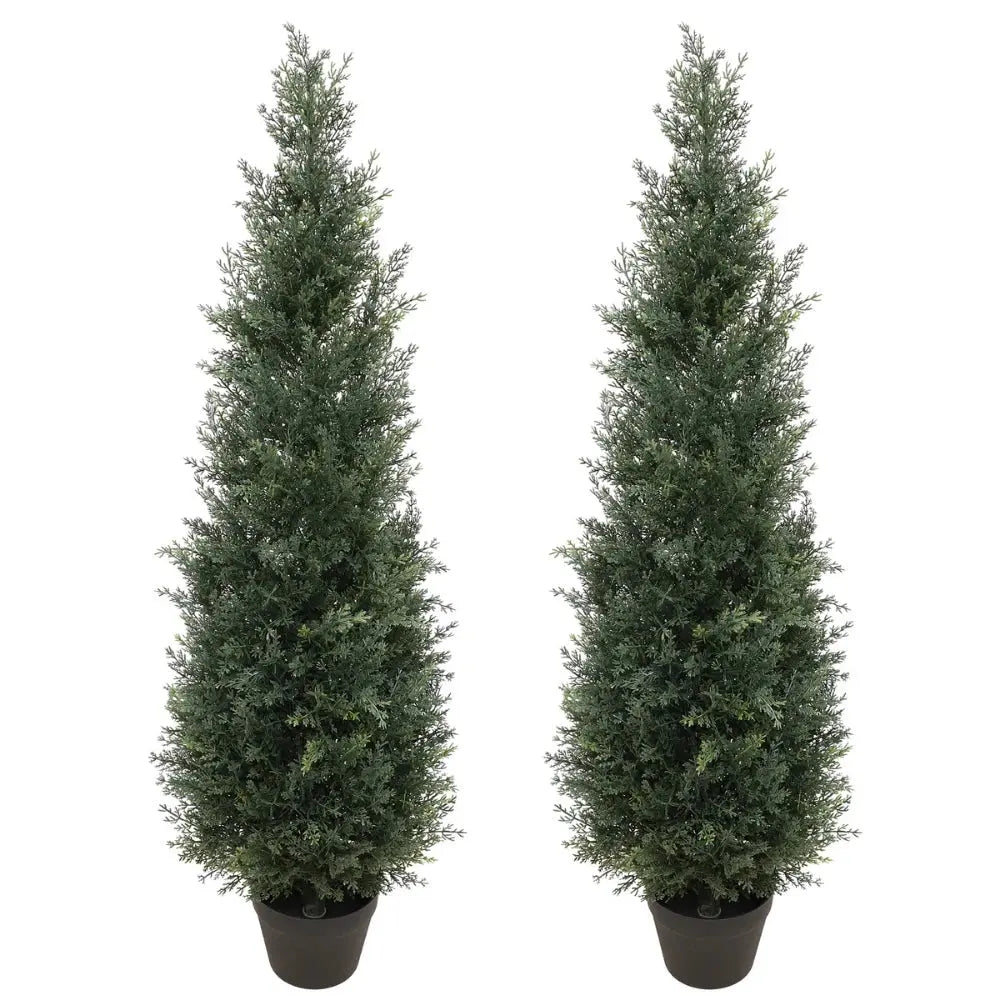
Then rotate — quarterly, a quarter turn, so no single face takes it all. And leave an air gap, because foliage pressed against a radiant wall cooks from behind. A 4ft cedar pair set clear of the wall outlasts the same pair tucked tight against it.

A roof over the planting beats any spray you can put on it.
Six things that genuinely slow color change
1. Shop for shade first — choose the position before the plant.
2. Rotate quarterly, a quarter turn at a time, so any shift stays even.
3. Rinse monthly. A hose on a gentle setting, or a damp cloth: you are removing mineral film, pollen and dust.
4. Get it off the hot surface. Pavers, railings and dark decking radiate; a pot with feet or a mat breaks the contact.
5. Give the most exposed pieces a holiday — if a west step turns brutal in July, swap in a simpler shape for those weeks.
6. Do not coat it with anything not meant for it. Household sprays tend to yellow, stay tacky or attract dust, which is worse than the fading you were preventing.
Also worth doing: aim irrigation heads away from foliage, and never let the pot stand in water.
Light green or dark green: choose foliage with the sun in mind
Color stops being purely aesthetic once a plant goes outside.
Dark green hides dust and chalking better and stays saturated in a bright spot. It absorbs more heat, so it suits bright rather than blasted positions — a dark green 3.6ft boxwood spiral pair is the safer pick for a sunny entry.
Light green reads brighter in photographs and is lovely in a shaded corner. In full sun it shows film and chalking sooner, simply because there is less depth to lose, so position the light green 3.6ft boxwood spiral accordingly.
Two-tone and variegated foliage is the most forgiving: the variation is already there, so a shift is much harder to see.
Flowering pieces are the exception. Blooms fade first, because a thin petal does a lot of visual work. If you love the 5.2ft bougainvillea, give it the most sheltered spot you have.

Blooms fade first — flowering pieces earn the most sheltered position you have.
What "UV resistant" usually means on a product page
This phrase gets used loosely, so it is worth decoding. In practice it generally means the material was formulated with additives meant to slow UV degradation. It does not mean immune, and it does not mean the plant will look the same indefinitely — and there is no consumer standard that lets you compare one seller's claim with another's, which is precisely why the phrase is cheap to print.
Be skeptical of absolutes. Anything described as "proof" against the sun, or as never fading, promises something the physics does not support. A stated warranty tells you more than a big adjective, and an honest return window more than either.
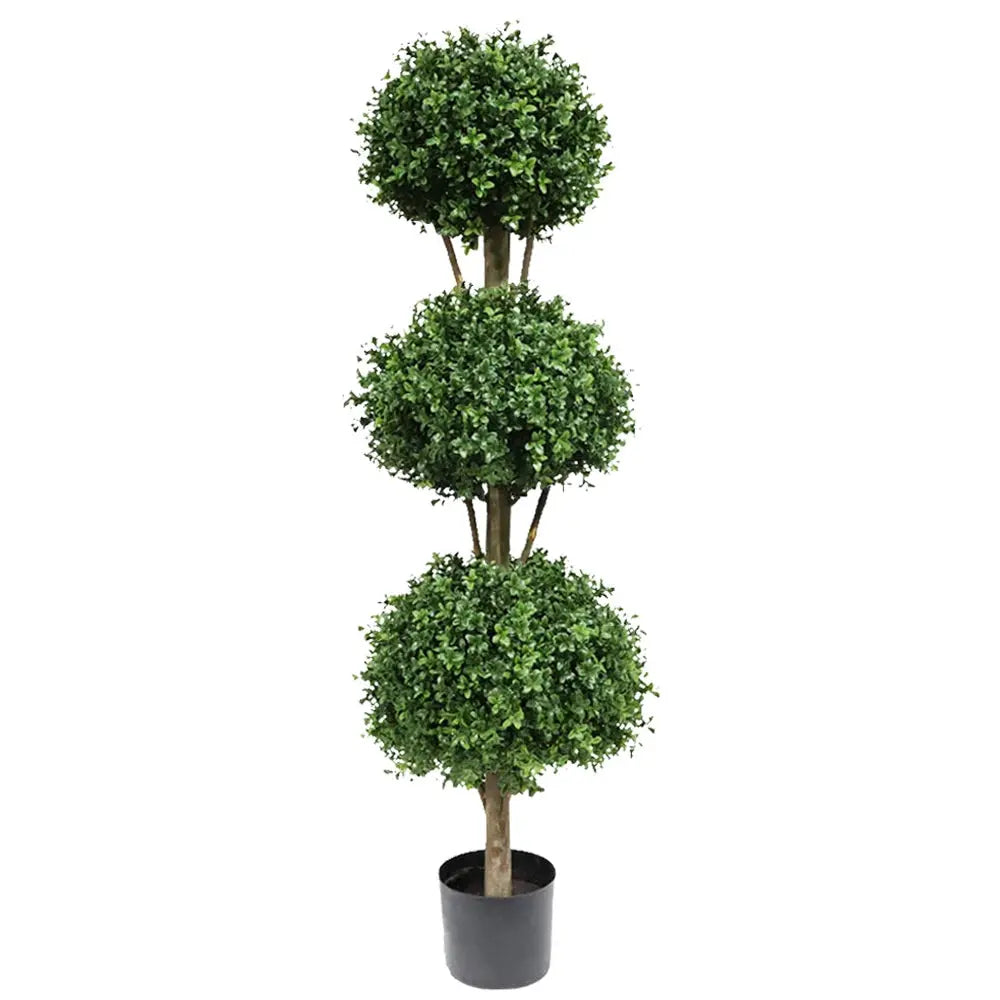
Ask narrower questions: is it described as suitable outdoors, where will I actually put it, and how long do I have to change my mind? A 56in triple ball boxwood topiary under an eave outlasts the same piece on an open west wall whatever the label says.

Siting beats labelling: one piece, two exposures, two very different outcomes.
Wind and rain: the pot is the weak point
Fading is slow and cosmetic. Wind is the one that ruins your afternoon.
Every plant arrives in a nursery pot with no added weight — deliberate, so you can slide and spin it while deciding where it lives, but a light pot on an exposed step or an upper-floor balcony goes over in a gust. Once you settle on a spot, drop the whole nursery pot into a heavier decorative planter. On a balcony, where wind funnels between buildings, that is not optional.
Two specifications people misread. The listed Weight is the total for the item as sold, so on a "Set of 2" it covers both pieces together. And the internal metal frame is rust-resistant — outdoors that is what lets a branch hold the position you shaped it into, season after season. A 4ft cedar pair framing a breezy walkway needs that heavier outer pot more than anything else.

The nursery pot is made to drop inside a heavier planter — especially somewhere windy.
Frequently asked questions
Do outdoor artificial plants actually fade?
Yes, eventually and to some degree. Speed is driven far more by exposure than by price: a piece under a roof in a mild climate can look close to new for years, while the same piece in all-day sun on a west-facing wall shows a visible shift much sooner.
Can I spray something on them to stop fading?
We do not recommend coating foliage with products not formulated for it. Household sprays tend to yellow, stay tacky or attract dust, and all three look worse than gradual fading. Shade, rotation and rinsing are what actually help.
Should I change the pot straight away?
For stability, yes. The nursery pot is designed to sit inside a decorative planter, and on an exposed doorway or a breezy balcony a heavier outer pot is the difference between a plant that stays upright and one that does not.
What if it arrives damaged, or the color is not what I expected?
Contact us within 30 days of delivery. Returns are accepted within 30 days subject to a 10% processing fee; return terms apply.
Give your outdoor greenery a position, not just a product
Most faded porch planters were not badly made — they were put in the one spot with no shade at all. Before buying, walk your entry at 9am, 1pm and 5pm and note where the sun actually lands.
Start with topiary plants for doorways and steps: pairs such as the 37in cedar pair and the 4ft olive triple ball pair read well flanking a sheltered entrance. For narrow spots, boxwood spiral topiaries take almost no floor space, and cedar topiaries hold a solid silhouette in a windier corner.
Everything ships free within the continental US (Alaska, Hawaii and Puerto Rico excluded), leaves our California warehouse within 24 hours on business days and arrives in 3–5 business days. If a piece turns out wrong for the spot, you have 30 days to return it — return terms apply.
Share:
Are Artificial Plants Safe for Cats and Dogs? An Honest Answer