
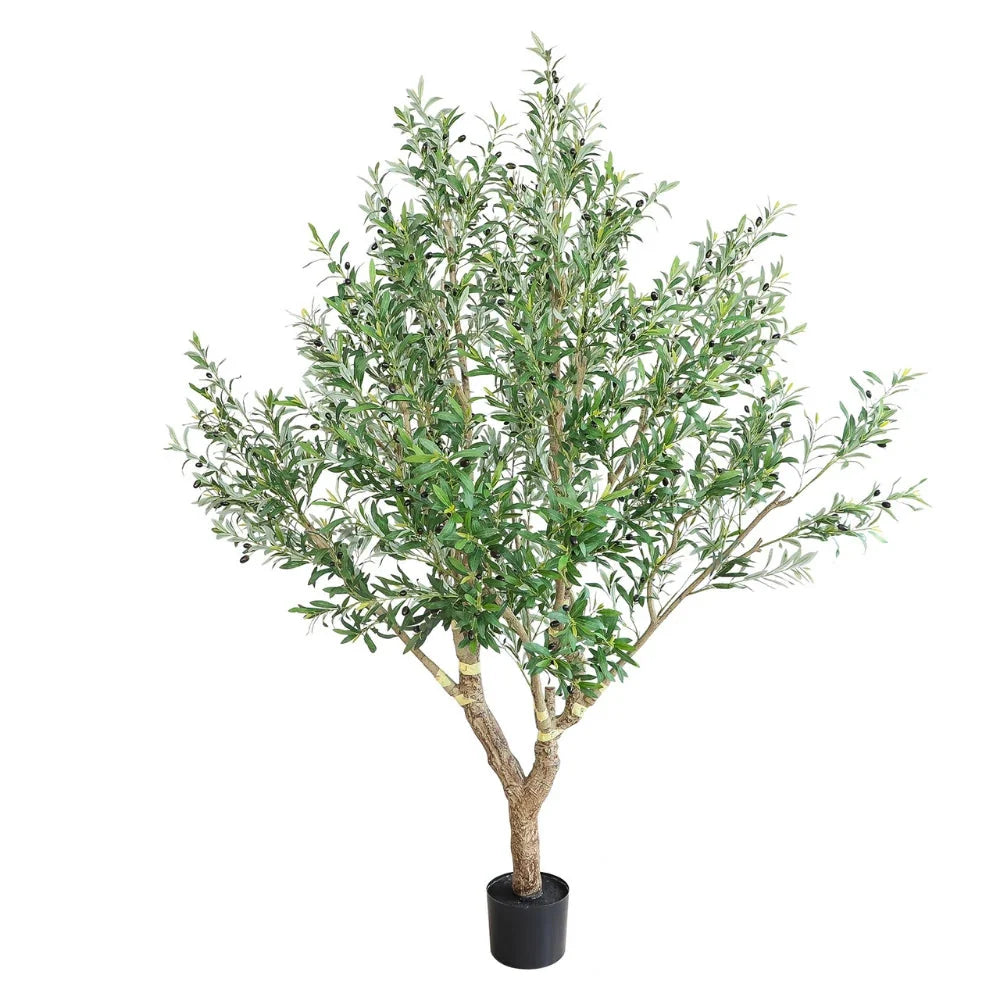
Why the tree in the box never looks like the tree in the photo
Open the carton on a 6ft faux tree and the first reaction is usually disappointment: a narrow bundle of branches pressed against a bare trunk, nothing like the full canopy on the product page. Almost always, nothing is wrong. You are looking at a plant that has not had its twenty minutes yet.
Three things happen on the way to your hallway. The carton is sized for shipping, not for the plant, so every branch is folded upward along the trunk. Compression does the rest — weeks under pressure teaches foliage to hold that fold, the way a sweater creases. And gravity is not helping: a box standing upright lets every branch settle into the same droop.
The photo was taken by someone who spent real time on it: every stem pulled out, every leaf separated, the whole thing turned and re-checked. That missing labour is the entire gap. Budget 15 to 25 minutes for a floor tree, 5 for a tabletop piece.

Twenty minutes of shaping is the difference between bundled twigs and a tree.
What you are working with inside those stems
Knowing what is under the surface changes how confidently you handle it. Our stems sit on an internal metal frame that is rust-resistant, and that is the detail that matters here: a branch holds the position you bend it into rather than springing back toward its packed shape.
Every plant also arrives in a nursery pot with no added weight, which is genuinely useful while you work — you can slide, spin and reposition it with one hand. It also means an exposed front step is not where the nursery pot should stay. Once you have settled on a spot, drop the whole pot into a heavier planter.
One specification people misread: the Weight figure is the total for the item as sold. When the title says "Set of 2", that number covers both pieces together.
Tools that help, and two that hurt
The list is short. Your hands — thumb pads give far more control on a slender stem than pinching with fingertips. A step stool for anything above about 5ft, because shaping the crown from below is the main reason trees end up flat on top. A second pair of hands for an 8ft or 9ft piece: one steadies the trunk, one works the branches.
Leave two things in the drawer. Heat: a hair dryer or heat gun can warp synthetic leaves beyond repair, and bending by hand already works. Cutters: nothing needs trimming — a stem that looks too long has simply not been bent outward far enough.
The top-down, inside-out method, step by step
Stand the tree up in roughly the spot it will live in, take off the wrapping without cutting anything, then work in this order.
1. Start at the top third. The branches near the crown are the shortest and most crowded, and they become unreachable once the long lower branches are spread below them.
2. Inside out, stem by stem. At each branching point, ease the innermost and shortest stem away from the trunk first, then move outward and finish at the tip. Grabbing the longest outer branch first drags the inner ones into a clump you then have to undo.
3. Bend in two planes, not one. This is the step people skip. A stem bent only outward gives you a flat disc, like an umbrella. Give each one a direction and an attitude: out at the base, then slightly up or down nearer the tip.
4. Separate the leaves. Flattened leaves stuck together in sheets are the biggest giveaway on a new faux plant. Fan the foliage apart along the last few inches of every stem. If you can see gaps and shadow through the canopy, you are doing it right.
5. Work around the trunk in quarters, finishing one quarter before turning, instead of picking at random branches and leaving one side bare.
6. Leave it slightly imperfect. Pull two or three stems lower than the rest, or let one branch reach further. Perfect radial symmetry is not something a living tree does.
7. Do the bottom row last. The lowest branches take the worst of the journey, set the width of the whole silhouette, and hide everything above them while you work.

Top third first: the crown is the part you cannot fix afterwards.
Adjust the method to the plant you have
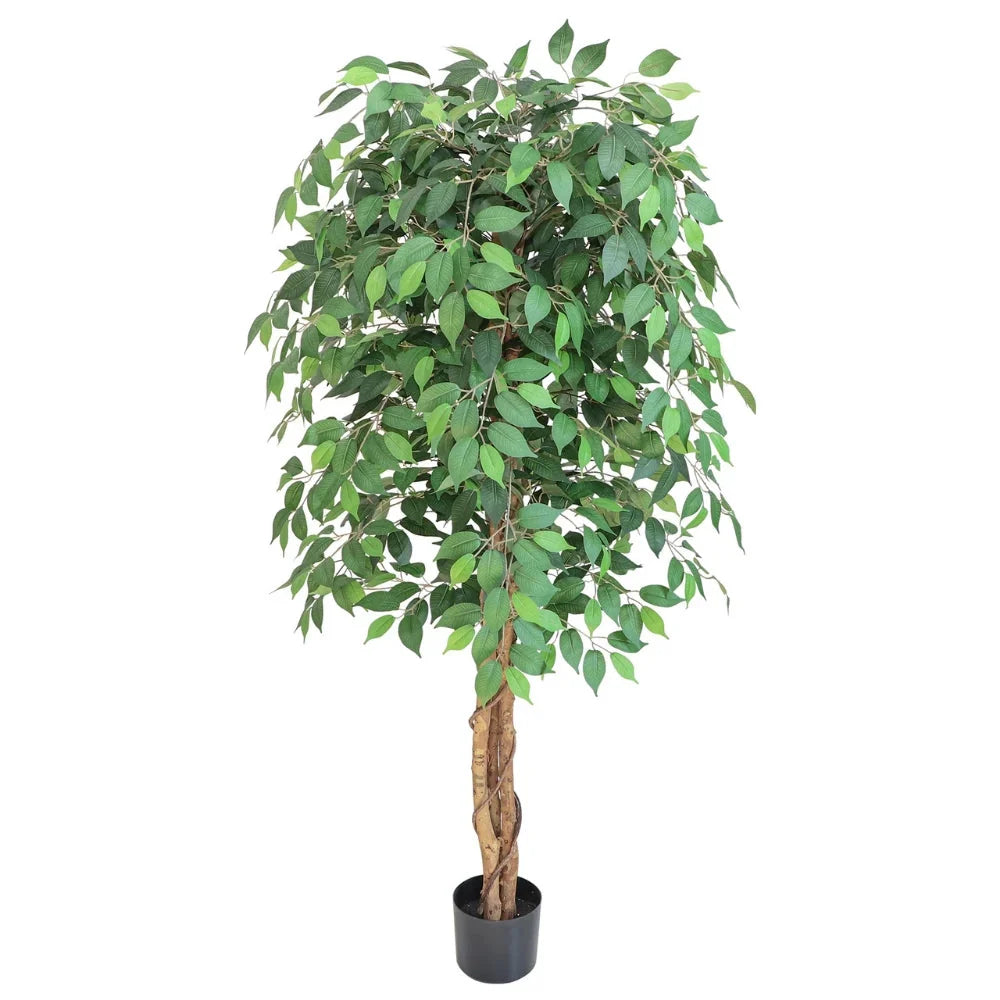
Branching trees. An 8.2ft olive tree or a 7.9ft ficus is shaped branch group by branch group, aiming for gaps you can partly see through rather than a solid ball. Where the ceiling allows, the 9ft olive tree wants the same approach at greater scale, which is exactly why it needs two people.
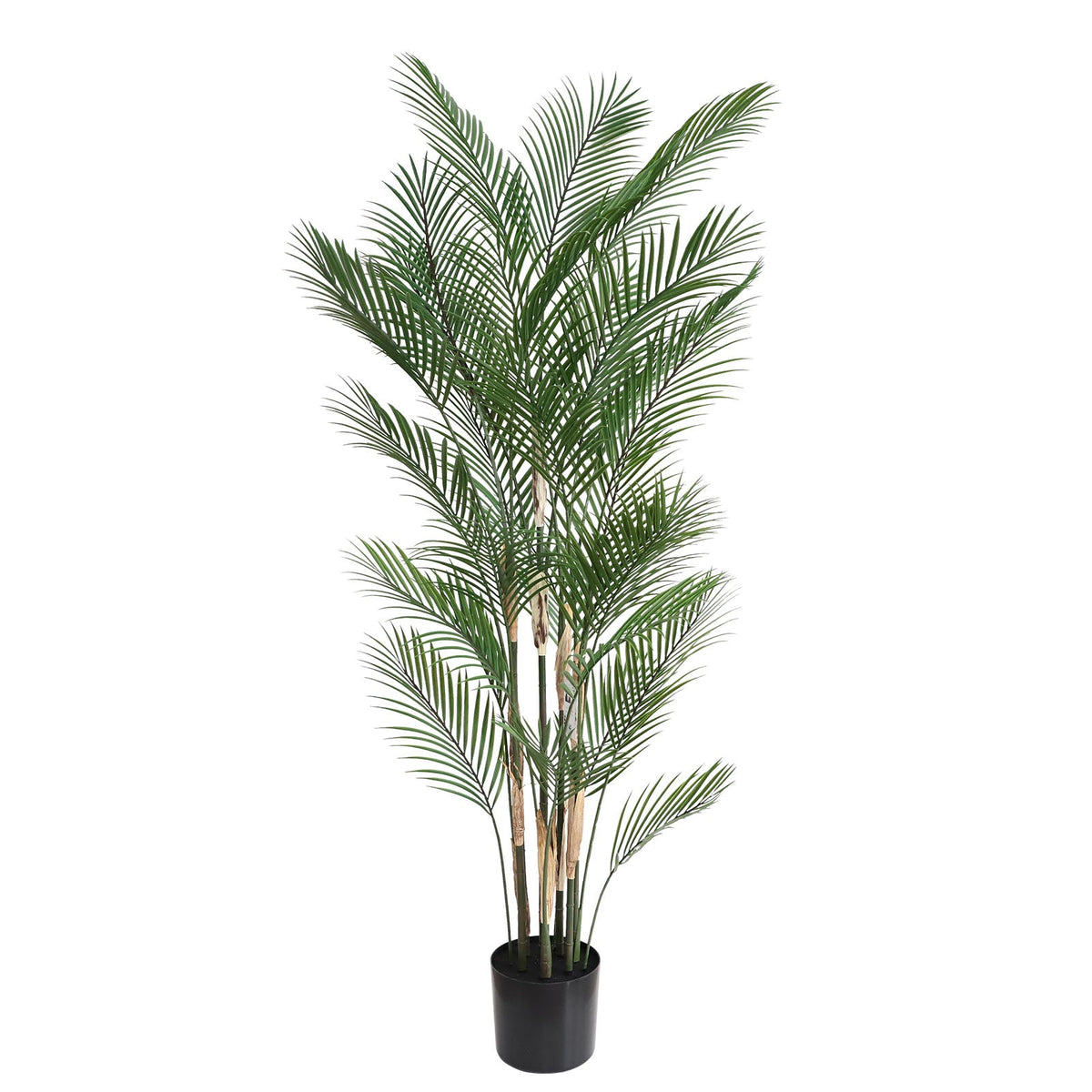
Palms and ferns. Fronds should arch, not stick out straight — curve the midrib rather than only the tip, and uncurl anything folded over in transit. The 71in areca palm responds well; so does a Boston fern with 88 fronds, where the work is mostly fanning fronds out in different directions.

Curve the midrib, then fan the fronds — straight fronds are what give a palm away.
Spiral and cone topiary. These arrive with the foliage compressed into an oval. Rather than hunting for stems, walk around the piece and tease the outer surface outward until it reads round from every side, then check from directly above, where a flattened top shows. The 3.6ft boxwood spiral and a 4ft cedar pair both come back quickly this way.

On topiary, reshape the surface rather than individual stems — and check it from above.
Flowering branches. Blooms sit at the tips, so grip below the flower and spread the branches until the clusters no longer touch. A 5.2ft bougainvillea looks dense and convincing once the flower heads have air between them.
Step back, turn it, then look again from the doorway
Shaping is judged from a distance, not from arm's length. Leave the tree and come back to it from the seat you use most, the doorway you walk through, and straight on. Then turn it a quarter turn: the face you worked on first is nearly always the best, and the back is usually still flat because patience ran out first.
If one side is genuinely thinner, resist bending more — rotating the tree so its fullest side faces the room solves it in ten seconds. Finish by looking down onto the crown from your stool.
Five mistakes that undo the work
1. Shaping it lying in the box — gravity works against you and you redo it all upright. 2. Bending only the tips — direction has to be set at the base, or every stem leaves the trunk at the same angle. 3. Over-symmetrising — a perfectly even outline reads as manufactured. 4. Skipping the bottom row, which leaves the tree top-heavy. 5. Shaping before choosing the final position — a shaped tree carried through a doorway is a compressed tree again.

Fronds falling in different directions are what separate a fern from a bundle.
Frequently asked questions
How long should shaping take?
About 15 to 25 minutes for a floor tree, 5 to 10 for a tabletop piece, and longer for anything over 8ft on your own. Much longer than that usually means you are re-bending stems you have already done.
Will the branches stay where I put them?
Yes. The stems sit on an internal metal frame that is rust-resistant, so a branch holds its angle instead of relaxing back toward the packed shape — and you can reshape it later after a move or a change of room.
Do I need a new pot straight away?
Not for the plant's sake; the nursery pot is meant to drop inside a decorative planter. The practical reason to size up is stability: for an exposed doorway or a breezy porch, put it into a heavier planter. For sets, the listed weight covers both pieces together.
Can I reshape a plant bought months ago?
Yes, and it is worth doing. Foliage settles over time and gets nudged by cleaning and passing traffic, so a five-minute pass once or twice a year keeps the shape you set.
What if the carton arrived damaged?
Bends usually come out by hand — work the stem gently back the other way, from the base outward. If the packaging was badly damaged in transit, contact us within 30 days of delivery; return terms apply.
Give one tree its twenty minutes today
If a plant is still standing roughly as it came out of the box, this is the whole job: top third first, inside out, bend in two planes, separate the leaves, and turn it a quarter when you think you are finished.
Starting fresh? Browse artificial trees for branching pieces and palms, artificial plants for ferns and tabletop shapes like the 4.9ft dracaena or the compact 27in agave, and topiary plants for spirals, cones and pairs such as the 3.9ft areca palms that frame a doorway.
Everything ships free within the continental US (Alaska, Hawaii and Puerto Rico excluded), leaves our California warehouse within 24 hours on business days and arrives in 3–5 business days. If the shape or size turns out wrong for the room, you have 30 days to return it — return terms apply.
Share:
Best Artificial Plants for Dark Rooms and Windowless Corners