
Why a dark corner defeats greenery that looks fine everywhere else
When faux greenery looks wrong, the plant gets the blame. It rarely deserves it. What convinces your eye is not the leaf itself — it is light striking that leaf at an angle, so one edge catches a highlight while the side beside it falls into shadow. That alternating pattern is what your brain files under "plant."
A windowless corner usually has a single light source, directly overhead, and light from one direction collapses every one of those edges into a dark mass. The same thing happens in a garden: a shady corner planted with dense, dark shrubs reads as a hole in the border.
Your eye also adapts to the brightest surface in view, so a corner beside a lit screen looks darker still, and warm household bulbs pull a mid-green leaf toward olive and brown.

Pale, open foliage holds its shape in flat light; dense dark greenery collapses into a silhouette.
Here is the useful part: a real plant needs light to stay alive. An artificial one needs light only to look right to you. This is a lighting problem, not a renovation problem.
Read the light you actually have before you buy
Five minutes of checking saves a return. The paper test: stand where you normally stand, at the time of day you normally use the room, and hold white paper at chest height in the corner. Bright enough to read small print? Mid-green foliage will be fine. Grey or faintly blue? Shop the pale, high-contrast end. Count your sources: one overhead fixture gives flat light; two from different directions create the cross-lighting that produces visible leaf edges. Check the sightline: the corner you see as you walk in is the one worth spending on.
Go lighter, not greener
This is the rule people break most often, usually by buying the deepest green on the page because it looks richest in a studio-lit photo. In low light you are not buying hue, you are buying value: a dark green boxwood in an unlit corner reads as a hole in the room, while a light green version of the same shape reads as an object. Put the light green boxwood spiral beside the dark green version and the difference is immediate — excellent on a sunlit porch, much harder work in a windowless hallway.
Variegation is the second lever: a leaf with two tones carries its own contrast, so it keeps definition when the room has none. And do not underestimate white — a white flower behaves like a small light source, drawing the eye exactly where you want it. A white cherry blossom tree does that at room scale.

Same shape, two values: the paler pair stays legible where the dark one would disappear.
Silhouette beats leaf detail every time
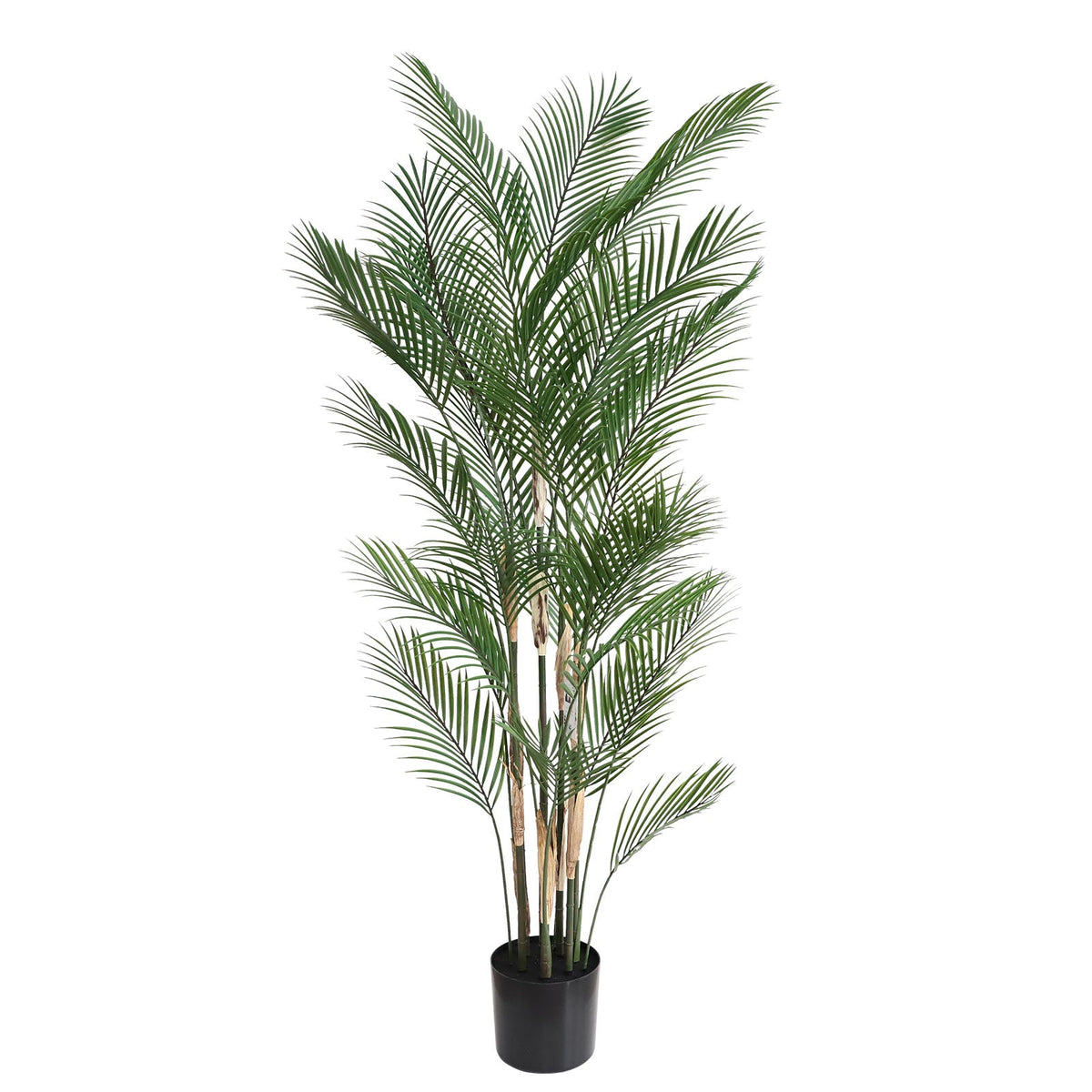
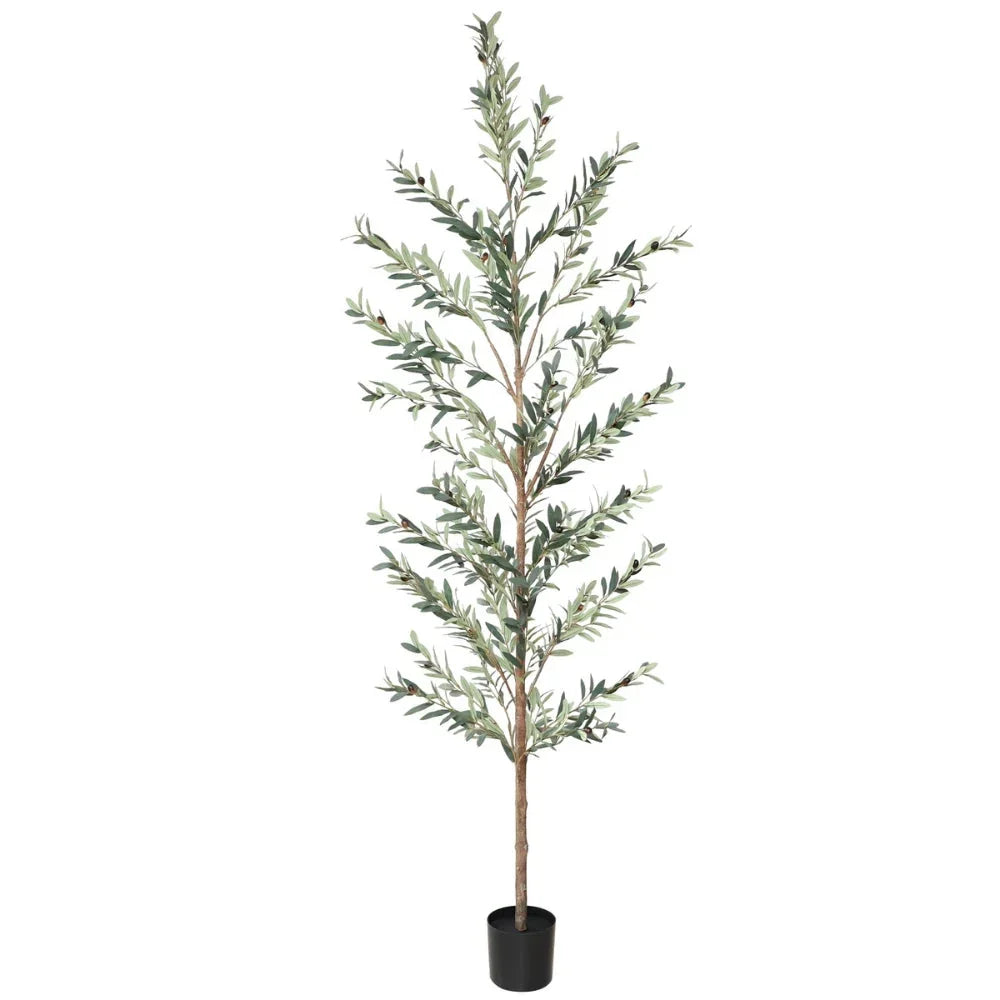
Past roughly six to eight feet, in dim light, nobody reads leaf detail — they read outline, which is why the most convincing pieces for dark rooms are also the simplest. Four shapes carry reliably. Upright swords: narrow, vertical, unmistakable even as a shadow — the 47in agave snake plant is essentially green sculpture and needs almost no floor width. An open umbrella crown: a palm throws fronds out on every side, so a lamp beneath it catches dozens of edges at once; the 71in areca palm is the strongest option. A column with a hard edge (spirals, cones) stays legible in flat light, and visible branch structure like an 8.2ft olive tree reads as a tree from across the room even when individual leaves are barely lit.

Upright, narrow silhouettes stay readable when there is no light to describe detail.
Put the light where the plant is
One well-placed lamp does more for a dark corner than any plant you could swap in. Position matters more than brightness: set it behind and slightly to one side, bulb above the top leaves, so light rakes across the foliage rather than hitting it head-on — shallow angles produce the highlights and shadows you are missing, while a lamp straight in front flattens the shape and picks up sheen. Go warm: around 2700–3000K keeps greens plausible; 5000K makes foliage look grey. Skip the ceiling downlight: a fitting directly above lights only the crown and leaves the rest in shadow. Use LED and leave a few inches of clearance. Put it on a timer and the corner is already working when you get home.
Size, height and the six-inch gap
| Spot | What works | Height guide |
|---|---|---|
| Empty floor corner beside seating | One tree with an open crown | 4–7ft, crown above the furniture back |
| Narrow gap beside furniture | Upright column, small footprint | 2.5–4ft, under 14in wide |
| Console or side table | Compact piece or a pair | 20–28in |
| Desk in a windowless office | One small upright | 20–27in |
| Dead-end hallway or stair landing | A matching pair | 3–5ft each |
| Bathroom shelf or vanity | White flowers or a small orchid | Under 24in |
The detail that matters most is also the easiest: pull the plant six inches off the wall. Foliage pressed flat has no room for shadow and merges into the wall behind it; six inches of air lets light get behind the leaves.
Our plants arrive in a nursery pot with no added weight, so they are easy to shuffle while you test positions. If you settle on a spot beside a door that opens to wind, drop it into a heavier planter — it will not hold its ground in a draughty entrance.

Six inches of air behind the leaves is what separates the plant from the wall.
Five picks that hold up without a window
Pair of 3.9ft areca palms — the fix for a blank hallway end or an unused fireplace. Symmetry carries the corner even when the light does not.
4.9ft dracaena — variegated leaves give it built-in contrast, and the narrow habit fits beside a bookcase or armchair.
27in agave plant — desk scale, the footprint of a coffee mug, still a clear shape from across the room.
2ft white phalaenopsis orchid — arrives in its own white planter and needs no arranging. Put it where a lamp can catch it.
Boston ferns, set of two — for a shelf you can light from above, since the fronds fall outward and catch light along their length.

White flowers act like their own light source in a room with none.
Four mistakes that make a dim corner worse
1. Buying the darkest green available. Dark green is the one colour that disappears in a dark room — right for a sunny porch, wrong for an interior corner. 2. Pushing the plant flat against the wall. No gap means no shadow and no separation. 3. Six small plants instead of one good one. In low light a cluster reads as clutter; one confident silhouette reads as a decision. 4. Matching the pot to the wall. A mid-grey pot on a mid-grey floor vanishes, taking the plant's base with it.
And check the corner after dark too: light that looks fine in the afternoon can throw a hard shadow up the wall at night.
Frequently asked questions
Do artificial plants need any light at all?
No. There is no photosynthesis to support, so nothing yellows or drops in a windowless room. Light matters purely for how the plant looks to you: happy with a soft silhouette, skip the lamp; want it to read as real from a few feet away, light it.
Will a dark, humid room damage them?
Darkness will not. In a bathroom with no window or extractor, let air move around the foliage rather than sealing it into a cabinet, and wipe it down as part of your normal clean. Our stems sit on a rust-resistant internal metal frame, so humidity is not the structural concern it would be with bare wire.
How tall should a corner tree be?
Tall enough that the crown clears the back of the nearest furniture — shorter looks like it is hiding behind the sofa, and anything brushing the ceiling feels in the way. Four to seven feet covers most living rooms.
Do I need a bigger pot?
Not for the plant's sake. Pieces arrive in a nursery pot meant to drop inside a decorative planter, so sizing up is purely a look — and a way to add weight if the spot is draughty.
Won't a lamp just show the dust?
It can, which argues for dusting before you switch it on. Light angled across foliage shows dust film more than ambient light does, so plan on a quick monthly pass with a cloth.
Fix the darkest corner you walk past every day
You do not need to treat the whole room. Pick the corner you see most — usually the one opposite the door — and apply three things: a pale or variegated plant, six inches of air behind it, and one warm lamp set behind and above it. An hour of work, and the whole room reads differently.
Starting from nothing? Browse artificial trees for floor-scale pieces that carry a corner alone, artificial plants for consoles, desks and narrow gaps, and artificial flowers for the white accents that pull the eye in a dark space.
Everything ships free within the continental US (Alaska, Hawaii and Puerto Rico excluded), leaves our California warehouse within 24 hours on business days and arrives in 3–5 business days. If the corner wants something else, you have 30 days to return it — return terms apply.
Share:
How to Clean Artificial Plants: The 10-Minute Routine That Keeps Them Looking New