
Why bathrooms are hard on plants — and why light is the real problem
A bathroom stacks three difficulties: no window, or a frosted one that borrows light rather than collecting it; humidity that spikes for twenty minutes and drops; and surfaces measured in inches, because the rest is basin, loo and door swing.
Light decides it. Most houseplants manage ordinary humidity well enough; far fewer manage the dim corner you have. Steam gets blamed, but anything near a bright window thrives — the windowless rooms give up.
If yours has a large bright window, keep real plants. This is for the rest: the internal bathroom with one small vent, the cloakroom under the stairs.
With faux you lose everything only living things do — new growth, change through the year, scent. You gain something looking the same in month eighteen, in the one room where that is hardest to achieve.
What humidity actually does to a faux plant
Synthetic foliage does not rot, so the common worry is misplaced. Three other things are real, and all avoidable.
Standing water at the base. A pot on a stone vanity top or a tub rim sits in whatever pools under it; water wicks into the base and marks both surfaces. Lift every piece on feet or a tray, empty saucers, stay clear of the shower spray.
Residue film. Toothpaste, hairspray and soap mist settle on everything in a small bathroom, including leaves. That film goes tacky and grips dust — the reason bathroom plants grey faster than living room ones.
Air that never dries. We make no mould-proof or moisture-proof claim for our foliage; airflow is the answer, so run the extractor and leave the door open. Our stems sit on an internal rust-resistant metal frame, so damp is not the structural worry bare wire would be.

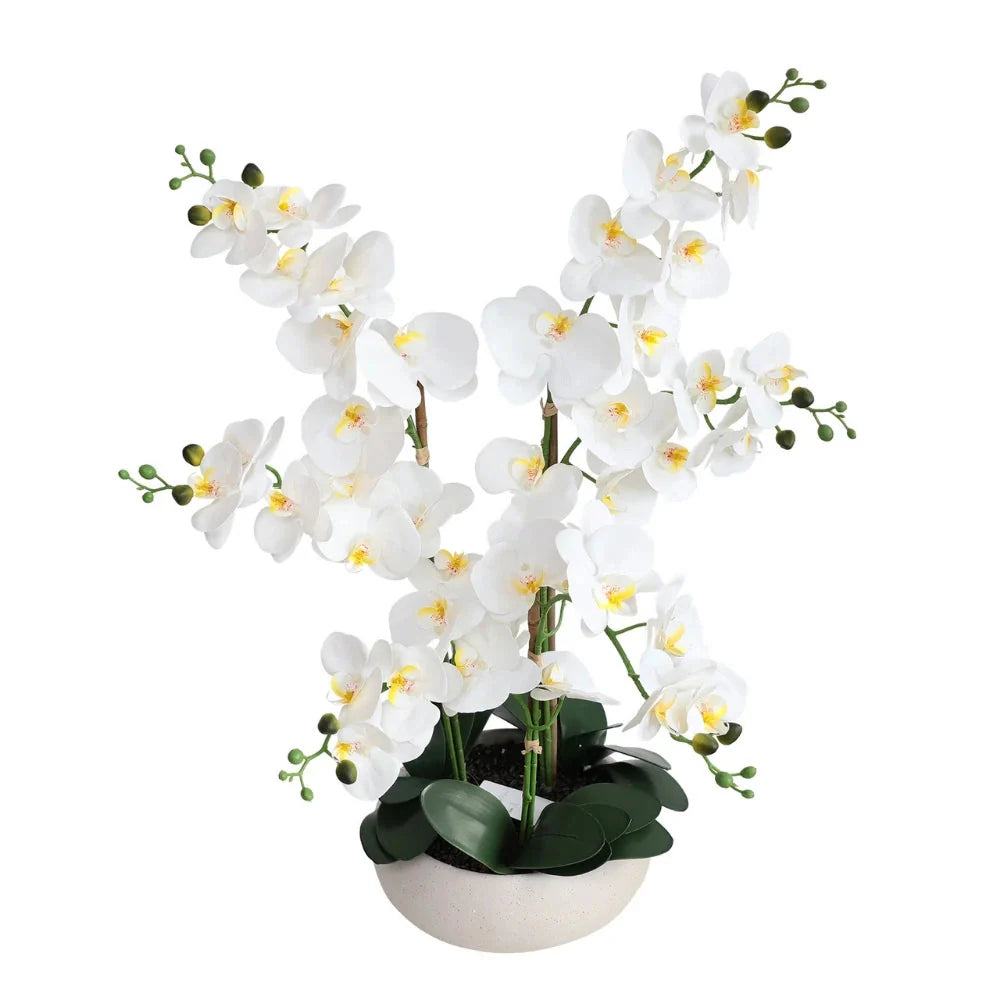
Two feet tall and already potted in white.
Pick by footprint and silhouette, not by the photo
Measure the footprint. A tea towel folded to size on the counter, tape on the floor. Most over-buying here comes from measuring the room, then finding eleven inches free once the soap is back.
Check sightlines. Anything at the sink must clear your eyeline at the mirror, and anything near the loo must clear the cistern — a plant you lean around twice a day gets moved, then put away.
Choose a silhouette against hard surfaces. Tile, glass and chrome leave a bathroom no soft edges. Movement — arching fronds, a loose crown — reads as deliberate; stiff glossy shapes read as plastic beside a mirror. Tight round forms suit a room of right angles, which is why a symmetric pair beats an artful cluster here.
Two specifications to read correctly. The listed Weight is the total as sold, so a "Set of 2" covers both pieces. Everything arrives in a nursery pot with no added weight in the base — handy upstairs, less so where people brush past: drop those into a heavier planter.
Zone 1: the vanity counter and the sink edge
Work outward from what the basin leaves — usually the strip behind the taps, or one corner.
An orchid suits that corner, and a 2ft white phalaenopsis is sized for it: tall enough to clear the taps, low enough not to crowd the mirror, potted in white against tile. Keep it out of the splash zone and check the cabinet door above.
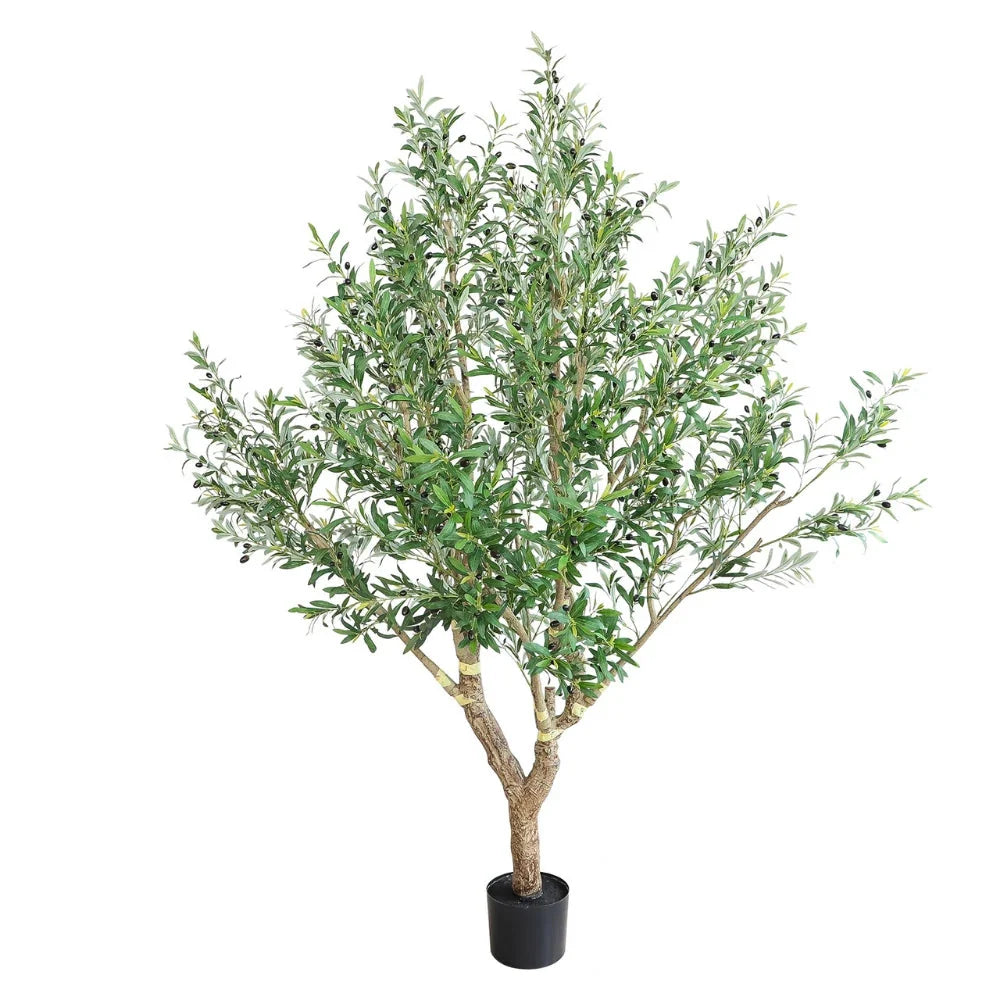
On a double vanity, symmetry beats one object every time — a pair of 20in olive ball trees at each end makes a deliberate line and leaves the middle free. They are sold as a set of two, so the listed weight covers both together; beside a single basin, one next to the soap does the job at half the width.

Two identical ends read as a decision; one object in the middle reads as clutter.
Zone 2: shelves, windowsills and the tank
These are narrow, high and dusted less often than they should be. Leave the top third of any shelf empty: it keeps things intentional rather than stuffed, and leaves room to lift pieces down.
Behind the loo, width constrains you and height does not. A 27in agave has the narrow profile for a ledge beside the cistern and is light enough to sit above ceramic. In a cloakroom — smallest room in the house, the one guests see — a small white rose in a pot is the right scale: one object, one shelf, done. Repeating the olive pair from the vanity up here is what ties the two zones together.
A deep windowsill takes whatever you want seen against daylight. Frosted glass gives glare rather than light, and a mid-green reads better in it than anything very dark.
Zone 3: the floor, the tub and anything that hangs
The floor is where bathrooms have space — and where clearance mistakes cost: check the shower door swing, the vanity doors and the laundry basket's route first.
In a room big enough, an 71in areca palm beside a freestanding tub puts height at the far end of the sightline, which is what you see from the water. Keep it off any bath mat and give it a tray with feet.
For the dead corner most bathrooms have beside the vanity, a 59in dracaena fits without crowding the door. Our taller pieces hold their silhouette at that height, but they arrive in a nursery pot with nothing in the base — a heavier planter solves that and hides the pot too.
Ferns are what everyone pictures in a bathroom, and one sitting flat on the floor is the placement that looks wrong — a bush put down. They want to arch: try artificial Boston ferns at the corner of a shelf above the tub, on a tall cabinet or a wall bracket. High and trailing suits the shape and stays clear of splashes.

A fern belongs above eye level, not on the floor.
Lighting a bathroom with no window
Most windowless bathrooms have one overhead light and a mirror fitting, and both are unkind to foliage. A downlight directly above a plant flattens it: no shadow, no depth, and every bit of sheen shows.
If there is a socket by the mirror, a second low source on the opposite side changes more than any rearrangement. Light travelling sideways across leaves creates shadow, and shadow is what reads as three-dimensional. Keep foliage clear of any fitting that gets warm, and in a dim room choose mid-greens — very dark foliage disappears into a corner.
A ten-minute routine that keeps it looking new
Weekly, one minute: a dry microfibre cloth over the leaves. That matters more here than it sounds, because dust landing on the tacky film grips.
Monthly, ten minutes: lift each piece down, wipe with a barely damp cloth and a drop of dish soap, then dry with a second cloth before it goes back. Do not soak foliage or submerge the pot, and skip solvents and anything abrasive — neither is needed for soap and toothpaste mist.
While you are there: check under every pot for standing water — including the floor piece in the corner, which nobody moves — wipe the ring off stone or wood, and run the extractor. We make no UV claim for our products, so keep anything with light pouring onto it out of direct sun.

The corner nobody uses is usually the one that changes the room.
Frequently asked questions
Can artificial plants get mouldy in a bathroom?
We make no mould-proof claim for our foliage, so treat airflow as the answer rather than the material: keep the base out of standing water, run the extractor, leave the door open after showers, and wipe anything splashed.
Can I put one inside the shower enclosure?
We would not. Constant spray and a wet floor are exactly what the routine above exists to avoid; outside or above the enclosure does far better.
Do they smell, or does the room get musty?
No scent at all — the honest trade-off, and what live plants give you that nothing faux can. Any smell in the room is ventilation, not the plant.
How long do they last in a humid room?
We will not put a number on it, because lifespan depends far more on placement than construction. Shape holds on a rust-resistant frame; colour changes, and sunlight decides that.
Do they arrive ready to place?
In a nursery pot, yes — which is meant to go inside something nicer. On a counter or shelf that is the whole job; a fern hanging from a bracket needs nothing but dusting.
Fill the room nobody decorates
Start where you look most: the vanity. Orchids are sized for a counter and already potted in white, then topiary olive trees if you have the width to work symmetrically. Above the tub or on a high shelf, artificial ferns do more for the room than anything at floor level; smaller artificial plants covers the ledges, tanks and cloakroom shelves where footprint is everything.
Everything ships free within the continental US (Alaska, Hawaii and Puerto Rico excluded), leaves our California warehouse within 24 hours on business days, and arrives in three to five business days. Returns within 30 days; return terms apply, and a 10% fee is deducted from the refund.
Measure the footprint first. In a bathroom that one step is the difference between a finished room and a windowsill waiting to be cleared.

Height at the far end of the room is what you see from the water.
Share:
Artificial Flowers for Weddings and Events: A Reusable Decor Plan